Advantages and disadvantages of out-of-home advertising
In today’s digital age, young marketers in particular are wondering whether the classic form of ‘outdoor advertising’ is still truly relevant. The answer is not clear-cut, but the fact that generations of marketers before them have also asked this question shows that outdoor advertising is here to stay. Perhaps this is also because it has such a significant external impact – it is very well received and is a particularly powerful marketing tool, especially when it comes to brand building and brand awareness. But let’s take an objective look at outdoor advertising from the outside.

Outdoor advertising is just the thing
We have it in the Introductory article in our blog series on Out of Home As has already been discussed, outdoor advertising is viewed far more positively than other forms of advertising. Perhaps this is partly because it intrudes less deeply into our private lives; we leave our ‘home’ and, in a sense, expect to be courted for our attention. Perhaps it is precisely those customers who are bombarded with digital advertising who find it relaxing to experience static, traditional, tactile advertising materials for a change? Or, to put it another way, it makes one feel far less disrupted in one’s daily life.
Reach and how much it costs
Of course, this depends heavily on the coverage of outdoor advertising. Once a town has been plastered with a series of advertising posters, the reach is enormous. However, even with more targeted, far more cost-effective campaigns in strategically well-chosen locations, it is possible to achieve very good results.
However, it is difficult to measure exactly how high this figure actually is, and it is based more on estimates. Unless, that is, you station knowledgeable observers in front of every poster to record every instance of eye contact over the entire period. And no, we don’t think that has ever been done in an advertising campaign. ‘Did she look at it, or just in that direction?’ No, probably not…
Have you seen this poster?
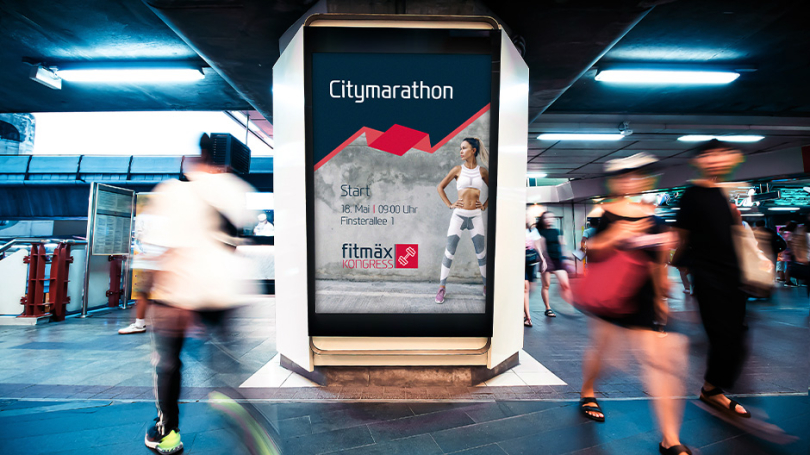
These topics probably won’t fill an entire evening, but perhaps part of one now and then. After all, large-scale poster campaigns in particular allow the advertising message to be communicated in a very catchy way. Nevertheless, one should adapt to the medium; there is little point in describing one’s products in 300 words, even if there were enough space for it. The Poster No matter how large it may be, the advertising message should still be readable and understandable in a matter of seconds. If you strike a chord with the spirit of the times or bring a brief smile to the faces of potential customers, you’ve essentially already won. Of course, you can give free rein to your creativity with any advertising medium, but traditional outdoor advertising is still in a league of its own within the advertising industry.

But there are also some drawbacks…
If a form of advertising is considered ‘traditional’, there is a reason for it. If we add the term ‘fast-paced’ to today’s digital age, it’s easy to see that outdoor advertising still carries a certain charm of slowness. Anyone who has ever been involved in organising an outdoor advertising campaign knows that nothing happens quickly in this field. From the planning, booking and production of the advertising materials right through to the final day of the campaign (i.e. when the poster is covered up), there is little room for change. You should therefore frame your messages with a long-term perspective in mind and factor in possible contingencies.
To use the phrase ‘the digital age’ for a third time, it may be difficult for young digital natives to understand why one cannot view the results of one’s advertising campaigns in real time, nor tailor one’s promotional materials closely to the target audience or react to their behaviour. It is only after several months that one really knows whether and how the campaign has worked – for example, through surveys or by assuming a positive impact on sales figures.
It’s all about the mix of media.
To put it diplomatically, it is probably the right media mix that brings success. Digital does not preclude traditional methods and should be factored in as part of a 360-degree campaign (otherwise it simply isn’t a full 360 degrees…). There is little point in using the exact same promotional material in both digital and print formats; it must be suited to the medium and only then can it achieve its full effect and enable an all-round successful campaign.
Regardless of all the pros and cons, one thing is certain: seeing your own advertising featured on a large-scale poster or displayed prominently on public transport makes the hearts of business owners and marketers beat a fair bit faster.