Everything about out-of-home advertising
Traditional outdoor advertising: Out of Home. Even after extensive research, we were unable to find out who coined this term. However, it can be explained roughly as follows: you’re sitting at home, looking out of the window and seeing an advert out there. Apart from this slightly cumbersome definition, one could simply call it ‘outdoor advertising’; this term is probably better known, and has been for quite some time. The earliest forms of outdoor advertising are thought to be thousands of years old and were already used to describe sales outlets and travel routes. So there must be a reason why this – arguably the oldest form of advertising – still works so well.

It’s actually quite difficult to narrow down
… and we’re giving it a go anyway. Outdoor advertising is advertising in public spaces – in other words, essentially anything that could be used as a medium for conveying a message. Although the forms, sizes and placements seem almost endless, they can nevertheless be reduced to a few classic formats – at least, these are the ones we recognise and identify as outdoor advertising.
Poster advertising
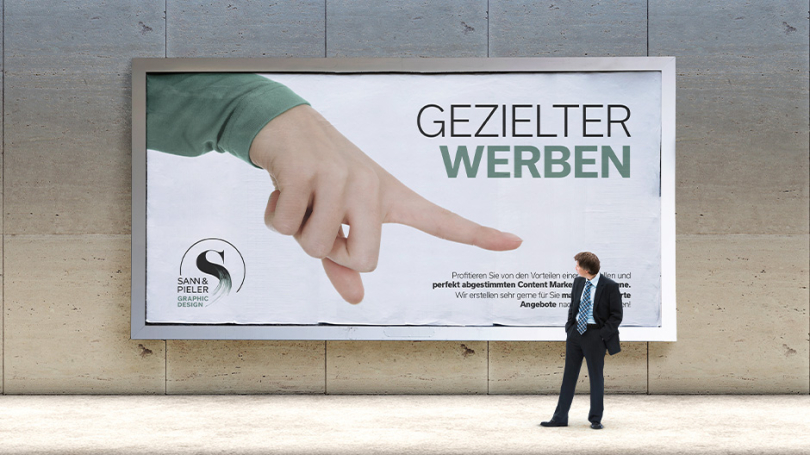
The flagship of outdoor advertising, the Posters. Large, impossible to miss, wide-reaching, right in your face. This can have both advantages and disadvantages. The big plus is immense reach; the slight downside is that it’s almost impossible to narrow down who the target audience might be. Of course, you could, for example, place tennis balls right outside the exit of a tennis centre, but such highly targeted poster campaigns usually end up being quite expensive and complicated.
Advertising on public transport
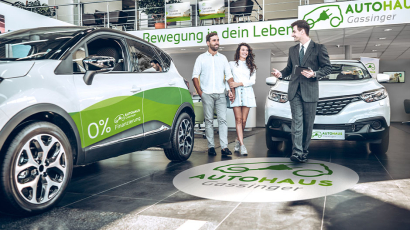
This is also a flagship product, but a more versatile one. This is because it can be placed on, in and around public transport. The advantage is that it is somewhat more targeted; the disadvantage is that it is perceived in slightly less detail.
The rest
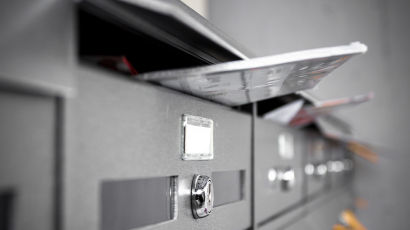
In reality, just about everything falls into this category and can be more or less effective. If we narrow these forms of advertising down to ‘everything delivered to your doorstep’, this could include Door hanger trade, but also Beer mat, Sticker, Bag or Postcards. The big advantage here is that this ‘out-of-home’ material could even make it into the home and is easily customisable.

Why does outdoor advertising work so well?
It’s probably impossible to give a definitive answer to this question. What is clear, however, is that it’s virtually impossible to do without this form of advertising. There aren’t any major GDPR regulations here; as an advertiser, you don’t need to obtain consent, and it’s difficult to click away from, throw away, switch off or turn away from. Somehow, it seems that people have got used to this form of advertising, as it is less intrusive and, above all, does not invade one’s privacy. You enter the public sphere, so to speak, and accept advertising, which is far less the case within your own four walls.

Outdoor advertising, but digital.
We began by discussing the millennia-old history of outdoor advertising, and naturally, a great deal has changed in this area too. At the very least, if one imagines an obelisk lining an ancient trade route and compares it to a digital display at a bus stop showing a video promoting an oat drink. The function is the same, but the possibilities have expanded somewhat. As mentioned, digital displays can show videos, but they also allow for targeted advertising, for example based on the time of day, location or weather conditions (this would make it possible to advertise oat drinks more successfully in some areas and milk-based drinks in others).
If we take this a step further, it may soon be possible to have highly personalised forms of advertising tailored to the viewer (which is already partly the case). To put it bluntly, these possibilities still seem a bit eerie at present, but they are certainly technically feasible. So, if you’re currently searching for a bicycle on your smartphone, it might well come cycling towards you on various bus stop displays.
Augmented reality options can also be implemented, which, when used with a smartphone, offer a wide range of creative possibilities – for example, videos that start playing once the digital poster has been scanned or simply brought into view, or even interactive features on the device.