The ‘Bullet Journal’ trend: tips and tricks for beginners
A jumble of thoughts, thousands of to-dos and little sense of the big picture – does that sound familiar? Then you’ll love this article! Because the following text is all about Organisation and Productivity. How exactly do you achieve these two points? Grab a bullet journal and let’s get started!
Bullet journaling is a trend that has taken the internet and social media platforms such as Instagram, YouTube and Pinterest by storm in a short space of time. But what’s all this about the Bullet Journal?
Behind the many creative ideas on this topic that can be found online lies a simple Notebook. This can be customised – whether it be into a personalised Calendar, a Diary, a Habit tracker, a To-do list, a Project planner or a combination of all these things. The result is an organised collection of the entire system of notes and slips of paper.
What is bullet journaling?
The inventor of the Bullet Journal method Ryder Carroll is originally from Austria and lives in New York. At a young age, due to his learning difficulties at school, he was diagnosed with a Attention deficit disorder diagnosed. Later, he realised that in his day-to-day life he was trying to focus on far too many things at once, which meant he couldn’t work productively. So he began writing down all his tasks, one by one, in a notebook.
Now that he had all his tasks written down on paper, his mind was clear and he was able to work through all his tasks systematically. When he showed this concept to his friends and acquaintances, he was surprised to find that they, too, were able to be much more productive using his system. He then developed the Bullet Journal method, which we now find adapted in countless variations on the internet and which Productivity for many people.
What do you need to start a bullet journal?
That’s the beauty of the bullet journal method: it’s simple and anyone can get started straight away – all you need is a Notebook with dotted pages and a Pen. Even though the majority of online posts on this topic are presented in a very creative and artistic way, a bullet journal doesn’t have to be elaborately designed – it simply needs to handy It adapts perfectly to your needs and is therefore customised just like you. Detailed tips for Your perfect bullet journal starter kit We’ve got these ready for you at the end of this post.
How exactly do you use a bullet journal?
Essentially, the Bullet Journal is a Recording tool – you can use it to take notes on Past, Present and Future Keep track of it. It helps you to Objectives, Requests and To-do list This helps you keep track of things. As a result, the Bullet Journal makes your everyday life easier. Its inventor, Ryder Carroll, provides beginners with a flexible framework for organising their journal.
These are the basics of any bullet journal:
1 | Key = Key = Legend
Firstly, it’s helpful to define different categories into which you’d like to organise your notes. The Bullet Journal method suggests the following key, which you can customise to suit your needs:

Also Colours These help you keep a better overview of the various sections in your bullet journal. For example, you can colour-code topics such as ‘household’, ‘leisure’ and ‘sport’ using different colours, so you can see at a glance what each note is about.
2 | Index = Table of contents
The great thing about the Bullet Journal is that you keep adding to it, so it flexible further developed. To keep track of everything, it’s worth creating a table of contents that is constantly updated. Some notebooks designed specifically for bullet journaling already include an index template. If yours doesn’t, you can create your own Create your own index with ease.
Whether you want all your pages to be indexed is entirely up to you. If the content is something you refer to time and again, it’s helpful to have an overview of the various pages and where to find specific topics.
3 | Future Log = Future Records
You’ve probably come across this one or two times Birthdays Forgotten your password or would you like to Holidays in one place? The ‘Future Log’ is a Annual overview. In this, you’ll find not only Tasks, as well as birthdays, Events or something similar, and make it visible to you at a glance. There are no limits to how you design your Future Log. From vertical to horizontal, from simple designs to elaborately decorated ones – anything that appeals to you is possible!
4 | Monthly Log = Monthly records
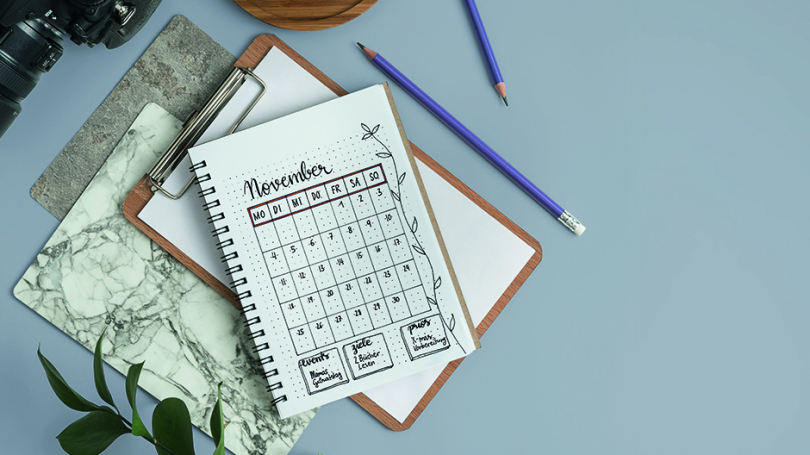
Once you’ve got an initial overview of the whole year, it’s best to take a look at the current or coming month. Just like the annual calendar, the Monthly calendar The basic structure of the bullet journal. Here you can see at a glance what’s in store for you in each month.
The difference compared to the annual planner is that the monthly entries are a recurring format That is, every time a new month begins, you create a new ‘Monthly Log’. For creative types, it’s a chance to let their imagination run wild with colours and decorative elements to suit the month.
Druck.at tip: At the end of each month, start creating the Monthly Log for the following month. Make sure you include any unfinished tasks in the new monthly plan if necessary. That way, no notes will get lost!

As well as your monthly calendar, you can also leave a little space for separate notes, such as your Objectives, which for the whole month to be recorded.
5 | Weekly Log = Weekly records
The Weekly Log bridges the gap between the monthly and daily planners. You might even find that the weekly plan is all you need and that you don’t require separate entries for each individual day. You create the ‘Weekly Log’ in exactly the same way as the Monthly Log, except that you list the individual days of the week. When planning your week, it helps to To-do list in various Categories to be categorised as follows, for example ‘Private’, ‘Work’, “Flat” and “Sport”. Make sure you skim through your Monthly Log every week and transfer any entries that fall within that week to your Weekly Log. That way, you’ll stay on top of your week and be sure to keep track of all your tasks and appointments!
If you’d like to keep track of how often you’ve done sport each week, for example, you can easily record this in your weekly planner. To do this, leave a space on the page and write down your Habits that you track you’d like, and tick off each day of the week on which you’ve completed a habit.

6 | Daily Log = daily records
To help you stay focused on your goals and plans every day, there’s the ‘Daily Log’. To use it, write down your Tasks, Dates and anything else that’s relevant to you right now. At the end of the day, you can Tick off completed tasks, unfinished items carried over to the next day move or the full version discard. That way, you’re guaranteed not to miss a single to-do!
The Bullet Journal helps you establish habits
As well as the bullet journal basics described above, your personal notebook can be adapted in many different ways. There are no limits to your creativity. You can also create a separate notebook for a specific topic alongside your everyday bullet journal. Whether it’s on the subject of Health, Travel, Cooking, Gardening – make the most of the area that brings you joy.
Even if you want to keep track of a habit, a hobby or anything else over a period of time, the Bullet Journal is perfect for this. For example, track your sporting activity, your Atmosphere or your Eating habits. It helps you with the Awareness or more time to create opportunities for activities that you’d like to incorporate more into your daily life.
Hand lettering: The Bullet Journal as a creative outlet
The wonderful thing about the Bullet Journal method is that it Productivity and creativity can be combined, if you wish. There are some real works of art in the form of bullet journals on the internet. Anyone who enjoys drawing can take up a new hobby whilst boosting their productivity. So-called hand lettering is often used in bullet journaling to jazz up the headings of individual bullet journal elements such as ‘annual planner’, ‘weekly planner’, etc.
But what exactly is hand lettering, and do you need to be able to do it to keep a bullet journal?
Hand lettering is a form of artistic handwriting, which you can learn and adapt to suit your own individual needs. However, it’s not essential if you want to work productively with your Bullet Journal. It’s simply a lovely way for creative people to combine to-do lists and hobbies. What’s more, a creative design for your Bullet Journal provides your daily dose of inspiration and motivation. If you prefer to work with a simply designed Bullet Journal, this is exactly the right method for you. Your Bullet Journal should be tailored to you and your needs!
The perfect starter pack for bullet journaling
Are you now brimming with motivation and keen to get started with bullet journaling straight away? We recommend the following supplies to get you started:
- A Notebook in A5 ‘dotted’ format
- A Liquid gel pens for keeping track of daily to-dos
- A Ruler
- A Pencil for sketches as well as black or colourful fineliners and Brush pens for more creative hand-lettering designs
Druck.at tip: Not all paper is the same. For bullet journaling, the pages of the notebook should not be too thin, so that the ink doesn’t bleed through. Make sure that the Paper thickness at least for 80g is available. If you want to use your bullet journal for the whole year and don’t want to switch, the number of pages is also a factor. With around 250 pages you can usually get by just fine for one year etc.
Bullet Journal templates
To help you get started with bullet journaling straight away, we’ve got a little treat in store for you. Click on the links on the right-hand side, where you’ll find two Download free bullet journal templates as PDFs You can:
- A Weekly planner in an attractive design, ready to print and easy to fill in yourself
- Blank Dotted bullet journal pages To print out if you want to design your Bullet Journal entirely yourself
Just print it out and you’re good to go – hope you enjoy it! :-)