Colour management – so you get exactly what you put in!
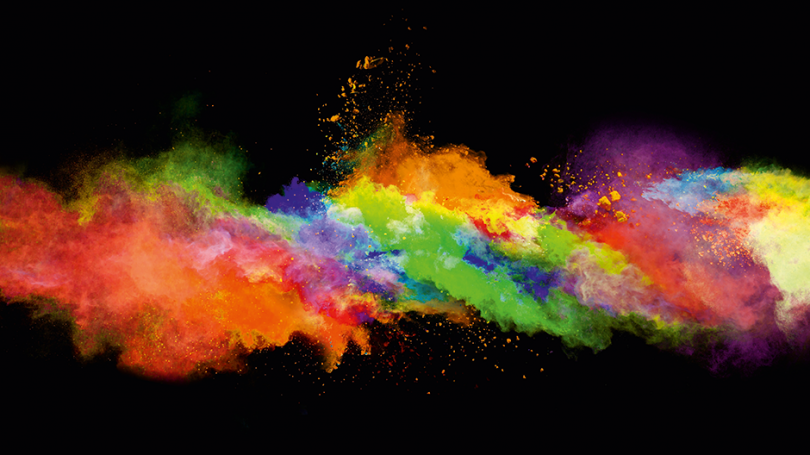
Back in your living room, you’re reminiscing about your holiday whilst looking at the photos you took yourself. But somehow it doesn’t look quite as you remember it? At sunset, was the sky actually much redder than the photo shows? Was the sea more turquoise and less dark blue than can be seen in the beach photos? Do you recognise these situations?
This is precisely the issue addressed by the Colour management. Colour management by druck.at However, this is not about beach photos and a camera, but rather, for example, about a poster design and a high-performance printer.
To ensure the printer can reproduce the colours exactly as specified in the design, there are a few things to bear in mind:
Not all colours are the same
What causes these differences? How do we perceive colours? It all depends on the source.

If the colour originates from a light source – for example, the setting sun in a photograph – these light colours consist of the Primary colours: red, green and blue (RGB).
If, on the other hand, a surface reflects light and thereby creates colours, these so-called Colour model based on cyan, magenta, yellow and key black (CMYK) composed of.
Every colour requires a profile
However, not every output device, be it a printer or a camera, can reproduce both colour systems. Instead, each output device covers only a specific colour spectrum. The colour spectrum of an output device is called Colour space or Gamut.
For example, if a design is created using RGB colours but the printer outputs in CMYK, discrepancies are inevitable.
That is why they founded 1993 eight industrialised nations the International Colour Consortium. In doing so, they developed a Consistent ‘colour scheme’. Since then, colour shades have been referred to as so-called ICC profile calculated and set up in the printing presses.
Knowledge is good, control is better

It is now up to the print shop to calibrate the printers so that they reproduce these colour values. However, a one-off calibration is not enough.
Rather, printing companies must constantly compare the colours produced with the target values and monitor quality. This is because printing presses change over time and must be continually readjusted.
Based on the results, the printed colours can be compared with the target values and the printing press readjusted if necessary.
This ensures the liquid ink retains its shape
However, all those bright colours do not enhance the overall appearance if they run or smudge. After all, ink is a liquid consisting of pigments, binders, resins and oils such as organic and rapeseed oil. This liquid is well suited for application onto the substrate.
However, to ensure the ink retains its shape, the binder is removed from it. This allows it to dry immediately on contact with air, leaving a dry ink film on the substrate.
The right mix for a place in the sun
But what happens if you expose paint not only to air, but also to other natural forces such as sunlight? Paints react differently to light and can fade.
The so-called Wollskala Yellow and magenta have lower values on the Woll scale and therefore fade more quickly than, for example, cyan and key black.

To ensure the longest possible lifespan, even when used outdoors, the inks must therefore be mixed in the correct proportions. In this way, druck.at is able to produce outdoor posters that are highly UV-resistant.
The right material ensures the colour stays vibrant even in the rain
However, it is not just the colour mixture that matters, but also the substrate onto which the ink is printed. For example, some art papers contain water-soluble varnishes. If such a substrate is exposed to the elements, such as rain, the ink simply runs down it.
It’s exactly the same when media have been treated with paste. If it rains on the paste, it washes the magenta ink off the media. The Blue-backed paper, druck.at for outdoor posters On the other hand, the material used retains its colour even in the rain and other weather conditions.
Expert advice to help you get your project off the ground
To ensure your colours look their best whatever the weather, you should choose the medium and colour mix carefully. But you don’t have to decide this on your own.
Druck.at We’re happy to advise you and help you create posters that accurately reproduce your colours, are long-lasting and can withstand wind and weather.