Everything you need to know about digital printing – history, benefits and more!
Alongside offset printing, digital printing is one of the most common printing processes of our time. But what exactly is behind this process, and what advantages does this type of printing offer? You’ll find this and much more information in this article.
An overview of the topics
1. Digital printing – what’s behind it
2. The history of the printing process
3. The printing process: How it works
4. The advantages of digital printing
5. Where is digital printing used?
6. Digital printing vs. offset printing
7. Conclusion on digital printing
Digital printing – what’s behind it
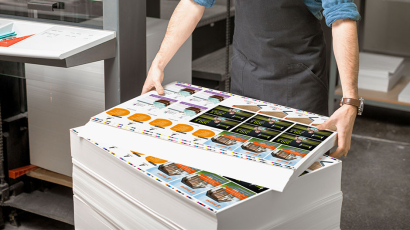
We don’t want to make it too complicated: digital printing is based on a specific printing system in which a digital print image is transferred to a printing press via a computer. Unlike offset printing, no fixed printing plate is required.
Particularly advantageous: Each sheet can be printed individually. This form of printing is therefore also Non-Impact Printing (NIP) as mentioned.

By the way: Most printers that we use at home also work on this principle.
The history of the printing process
You might not realise it at first glance, but the origins of digital printing actually date back to the 1930s:

1938 Chester F. Charlston established himself through the invention of the Electrophotography, also known as xerography, forms the basis of the method. However, the technology did not gain initial traction until some time later – specifically in 1944 at the American Battelle Memorial Institute, a contract research organisation.
1950 followed by the first photocopier which was also based on this innovative technology – but the hoped-for success failed to materialise.
Around 10 years later, the printing industry also began to take an interest in digital printing. The 1959 Published “Model 914”, weighing over 300 kg
The printer sparked such great interest that around 200,000 copies were produced right up until the 1970s.
Subsequently, the machinery and technology were further improved, enabling them to become established in everyday use.
The printing process: How it works
Whilst offset printing works on the principle of water and oil, digital printing uses electrical charges in use. The individual steps of the process
are illustrated by the graphics below.
The complete process:
- The ionisation of the photoreceptor causes a negative charge produced.
- The areas where the printing ink (toner) is not to be applied are indicated by means of a Laser beam unloaded.
- The positively charged toner adheres only to the negatively charged areas of the photoreceptor. There, a Image upside down Created.
- The paper becomes negatively charged, so the positively charged toner is attracted to the printing substrate. A Image oriented correctly.
- To fix the toner colour onto the paper, Oil, Pressure as well as a intense heat (up to over 200°C) required: A heated roller ensures that the ink adheres to the respective printing material by melting.
Note: The printing oil serves merely as a separating layer to ensure that the toner is transferred to the substrate and does not stick to the roller.

The advantages of digital printing

Flexibility: No static printing plate required; even small print runs can be produced with ease.

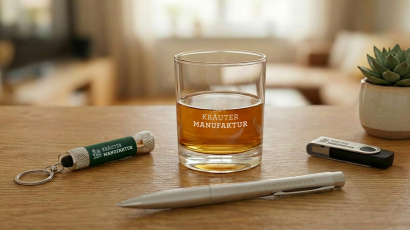
Wide range of applications: Modern equipment enables digital printing on a wide variety of substrates, such as paper, wood and glass.

Short production lead times: The products are usually printed and ready within 1–2 days.

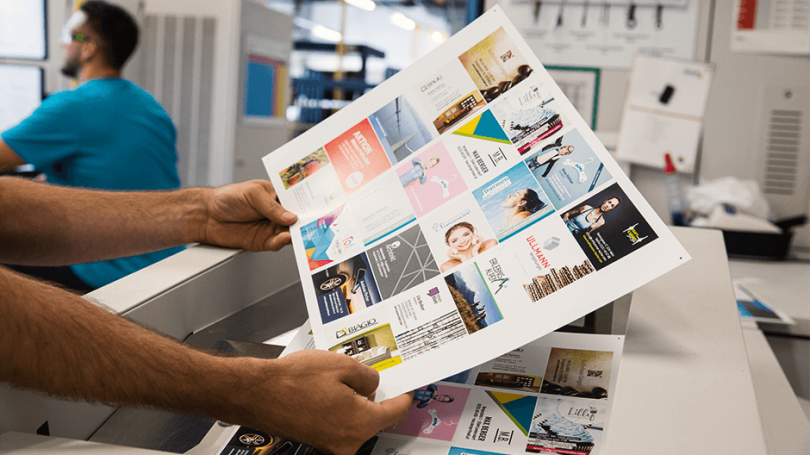
Customisation: The personalisation of the desired product, such as Business cards or Flyer… there are no limits. The only requirement is a digital file of the desired product.

High quality: Consistent print and colour quality is guaranteed as far as possible.

Cost-effective: Digital printing offers excellent value for money, particularly for small print runs.
Digital printing vs. offset printing
Despite a range of advantages, digital printing is not always the best choice. But in what ways does offset printing actually outperform digital printing?
When it comes to colours, the differences become clear: Whilst digital printing uses the primary colours (magenta, cyan, yellow, black), offset printing also allows for spot colours. Furthermore, due to technical limitations, digital printing may result in slight colour variations; offset printing is more precise in this respect.
Would you like more information? Take a look at the article on this topic Offset printing Gone!
Conclusion on digital printing

Even though digital printing isn’t the leading method in every area, it has become an indispensable part of day-to-day business. Digital printing has long since become established in our business too. We’re always happy to use it to produce the products you’ve customised, such as Posters and Banner to produce at a rapid pace.
More information on printing processes
What printing processes are available?
The main printing processes at a glance
Offset printing: this includes letterpress, flexographic printing and letterpress
In letterpress printing, the printed areas are raised. All information >>
Flat printing: offset printing
Offset printing is known as indirect printing process (Printing takes place via a roller). All information >>
Printing method: screen printing
Through-printing is particularly well suited to moulded objects such as bottles. All information >>
Gravure printing
In the rotogravure printing process, the recessed areas are filled with ink and printed. All information >>
Digital printing
In digital printing, the print data is sent directly from the computer to the printing presses.
Full details on the various printing processes are available here.
What is digital printing?
Digital printing refers to those printing processes in which the print image is transferred directly from a computer file to a printing press. Unlike other printing processes, no static printing plate is used; the intermediate step of printing plate production does not take place in digital printing. It is therefore a form of so-called non-impact printing (NIP), or ‘contactless printing’.
For each print run, a specific pixel address is generated within the print format. This allows a unique print image for each copy. This makes digital printing particularly flexible when it comes to personalised, customised printing.
The most common digital printing methods are laser printing and inkjet printing. They are characterised by high printing speeds and therefore represent a sound alternative to other printing methods for large-scale production runs. Digital printing is also a cost-effective option for small print runs.
What are the advantages of digital printing?
One of the biggest advantages of digital printing is the good value for money for printed products with small print runs such as personalised invitations and greeting cards, or various other printed products ranging from stationery and photo products to business cards in small quantities. Small print runs are more cost-effective with digital printing than with other printing methods, whilst maintaining the same high quality.
Further positive aspects include the high degree of flexibility and customisation as well as related items such as the short production time. No static printing plate is required, so even small print runs can be produced flexibly, provided the desired product with the relevant design is available in digital form. Furthermore, a wide range of materials are suitable for digital printing – apart from paper, it is also possible to print on wood or glass, for example.
Digital printing is just as flexible when it comes to size. Whether small stickers or large billboards – with digital printing, you can Printed products of all sizes implement.
Digital printing therefore offers a number of advantages that make it the ideal choice for achieving the best possible result.
When was digital printing invented and how has it developed?
The foundations for digital printing were laid as early as the 1930s, when the American physicist and patent attorney Chester Fr. Charlston 1938 the Electrophotography (also known as xerography). However, his invention only gained traction in the 1940s when it was patented by the Haloid Company (now Xerox).
Published later 1950 the first photocopier, known as ‘Model A’, which operated using a technology just as innovative as electrophotography.
Around 9 years later, this technology became of interest to the printing industry as 1959 the Printer model “Xerox 914” was launched on the market. It became well-established and remained in production until the 1970s. Then Xerox’s patents expired, and so, for example, Canon the right moment to "NP-1100" black-and-white photocopier to present.
1973 Xerox launched the world’s first colour photocopier for plain paper out.
Consequently, the development of machinery and technology took its course, meaning that today we can count digital printing amongst the most recent, yet also the most common, printing processes.